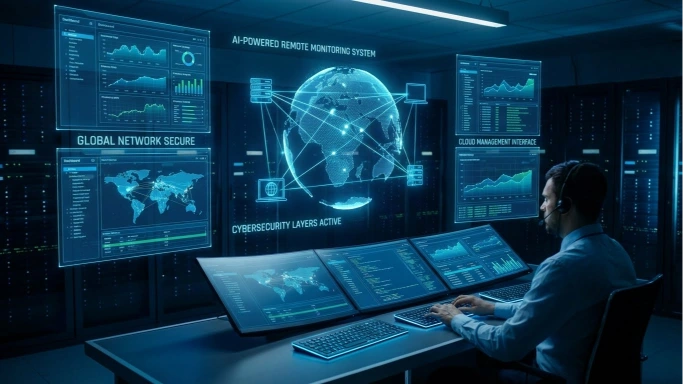
In today’s rapidly changing world of technology, remote control over computers and other information technology systems is no longer a matter of comfort; it’s a need. Small businesses and other corporations have been using remote monitoring and management software in order to keep their systems safe and running in the best possible way. In order to analyze what the future holds in this sector, it’s essential to refer to the IT PC RMM Solutions Technology Trend Timeline.
Table of Contents
The Early Life of IT PC RMM Solutions
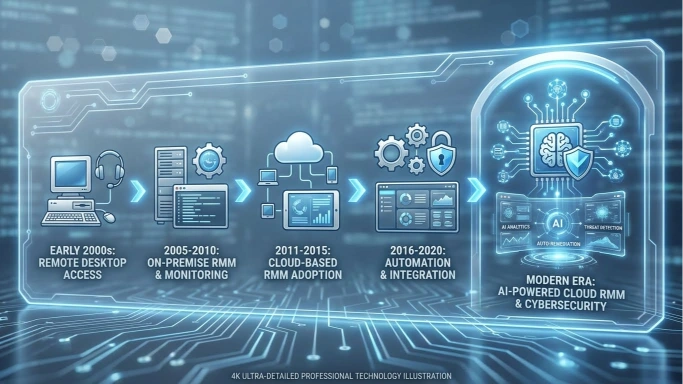
The IT PC Remote Management Tools technology trend started in the late 1990s or early 2000s, during which IT organizations still relied on direct computer access. This phase represented the days when system administrators had to physically visit computers to implement corrections, correct errors, or resolve problems. During these periods, remote technologies did not have many advanced functionalities but mainly focused on remote desktop connectivity.
As organizations began venturing into a global market, the need for a more controlled environment arose. Thus emerged the first generation RMM solution. It provided the means for the administrative team to check system status, disk usage, and performance indicators on a single platform. Although primitive, it was a precursor for contemporary remote management of PCs.
Phase 3: Growth Phase – Automation & Scal
In the period between 2005 and 2015, the timeline of the technology trend in theIT PC RMM tools experienced tremendous growth. This era also marked the beginning of automation in the aspect of IT management. RMM tools introduced automation in patch management, scheduling, and alerts. Now, it was possible to prevent rather than react to issues.
A significant role in the second phase for the growth and development of RMM was played by MSPs or Managed Service Providers. With an increasing number of businesses outsourcing IT support, RMM solutions were made more scalable and simpler to use. Online dashboards replaced traditional in-house solutions, enabling IT professionals to handle hundreds and thousands of PCs across the globe.
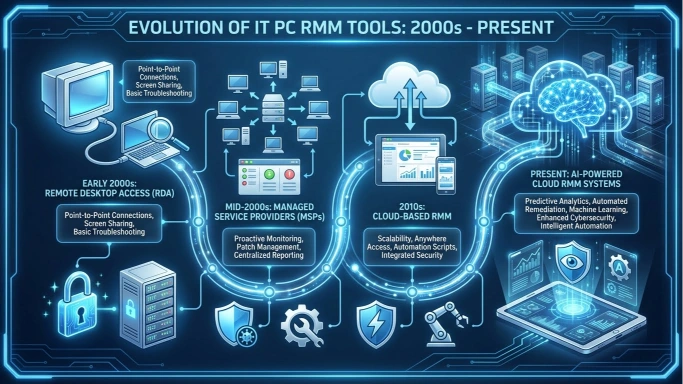
This phase also experienced enhancement in the area of reporting and analytics. Performance trends could be measured, problems repeatedly identified, and decisions made based on data. The technology trend for IT PC RMM tools during the phase:
Security Becomes a Priority
After 2016, threats from cybersecurity increased across various levels of sophistication. As a consequence, a drastic change took place in thetechnology timeline for RMM for IT PCs. RMM evolved from merely monitoring PC performance to becoming an integral component of an IT security plan.
The presence of real-time threats, endpoint protection integration, or vulnerability scans is now the norm. The tools are now used alongside antivirus software and endpoint protection. The growth in the cases of ransomware means that the remote solution has ensured the integration of backup management/disaster recovery.
Simultaneously, there was an increase in the kind of compliance that businesses needed to adhere to. RMM software responded to this challenge by incorporating audit logs, reporting, and role-based access controls. This ensured that businesses complied with set regulatory standards in addition to remote access security.
The Remote Work Revolution
The COVID-19 outbreak has advanced the timeline for technology trends in IT PC RMM tools like never before. Suddenly, businesses altered operations to a remote and hybrid workforce model. The technology required for IT to assist and monitor devices situated in their employees’ homes, cities, and countries was in dire need.
Modern RMM technologies escalated with the addition of lightweight agents, rapid deployment capabilities, and advanced facilities of remote support. Integration with the helpdesk, remote scripting, and self-healing automations are now the need of the day. IT PC RMM solutions evolved from being ‘background’ utilities into being ‘business-critical’ platforms.
This phase also brought out the importance of user experience. The IT departments were in need of user-friendly interfaces, whereas end users were expected to remain unaffected. Therefore, there was a focus on simplification and reliability of systems.
Current IT PC RMM Solutions Technology Trend Timeline Tools Currently, there are a variety
The present state-of-the-art trends in IT PC RMM tools are dominated by artificial intelligence and cloud innovations. Artificial intelligence-assisted real-time monitoring has predictive capabilities for potential failures, and machine learning capabilities continue to eliminate false alarms. Smart technologies enable IT professionals to manage strategic business areas and not only focus on maintenance.
Cloud-native RMM solutions have also become the norm. These solutions provide faster upgrades, scalability, and smooth interoperations with other technology tools like ticketing and asset management. Some security solutions based on zero trust have also been incorporated for smooth remote access.
Another emerging is unified endpoint management (UEM). PC-based RMM is expanding to cover laptops, smartphones, and IoT devices. It is reflecting a shift in the IT landscape where companies are required to handle numerous devices.
The Future of the IT PC RMM Tools Technology Trend Timeline
Looking into the future, the trend timeline for the IT PC RMM tools speaks about increased automation and intelligent decision-making. Future RMM products will probably include completely self-contained remediation capabilities where systems automatically discover and correct problems on their own.
Integration with AI copilots, improved behavioral analysis, and more comprehensive cybersecurity infrastructure are expected to become common. Sustainability could also enter into it, with RMMs facilitating energy consumption reduction for organizations through optimizing system performance.
Since companies have been embracing digital transformation, IT PC RMM technology will always form the central aspect of effective IT management. By comprehending the technology trend timeline, organizations can select the most appropriate tools to remain ahead in this more and more connected world.
Conclusion
The technology trend timeline for the IT PC RMM tools indicates the type of remote management that has evolved over the years, from mere monitoring to intelligent security-enforcing systems. The tools have transformed the manner in which IT professionals operate, from doing the repairs manually to using AI to automate the processes, and RMM tools will have a bigger role to play in the future with advancing technology.