
Lighting has always played a crucial role in human progress. From fire and oil lamps to electric bulbs, each innovation has changed how people live, work, and build cities. Among these inventions, fluorescent lighting stands out as one of the most energy-efficient and widely used technologies of the modern era. Yet many people still ask an important historical question: when were fluorescent lights invented?
This article explores when fluorescent lights were invented, the science behind them, the inventors involved, and how this technology transformed homes, offices, industries, and public spaces around the world. Written in a fully humanized and SEO-friendly style, this guide explains the full story behind fluorescent lighting.
Table of Contents
Lighting Before Fluorescent Technology
To understand when fluorescent lights were invented, we must first look at what came before them. Early electric lighting relied on incandescent bulbs, which produce light by heating a filament until it glows.
While effective, incandescent bulbs wasted a large amount of energy as heat. Scientists and engineers searched for better solutions, leading to experiments that eventually answered when fluorescent lights were invented.
Early Experiments with Fluorescence
The concept of fluorescence existed long before practical fluorescent lights. Scientists in the 19th century observed that certain gases and materials glowed when exposed to electricity.
These early discoveries laid the scientific foundation for when fluorescent lights were invented, even though the technology was not yet ready for everyday use.
The First Practical Fluorescent Lamps
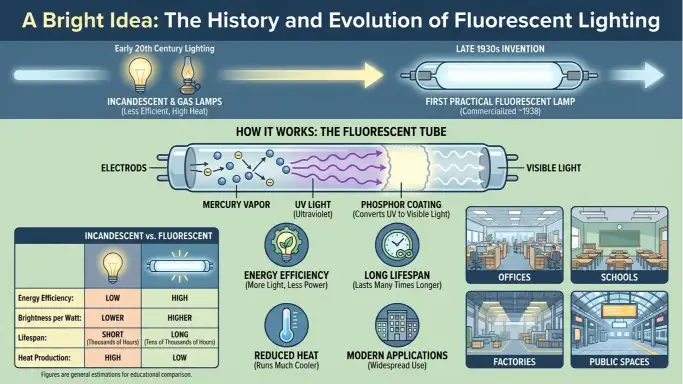
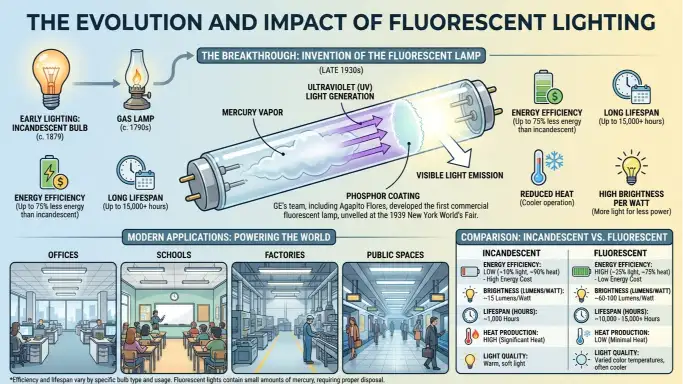
The modern fluorescent lamp was developed in the early 20th century. In 1938, General Electric introduced the first commercially viable fluorescent lamps to the public.
So, when people ask when fluorescent lights were invented, the most widely accepted answer is the late 1930s, when they became practical, affordable, and safe for mass use.
Key Inventors Behind Fluorescent Lighting
Several inventors contributed to fluorescent lighting, but one important figure was Georges Claude, who previously developed neon lighting. His work with gas-discharge lighting influenced fluorescent lamp design.
Thanks to these innovators, the question of when fluorescent lights were invented became associated with a major breakthrough in lighting efficiency.
How Fluorescent Lights Work
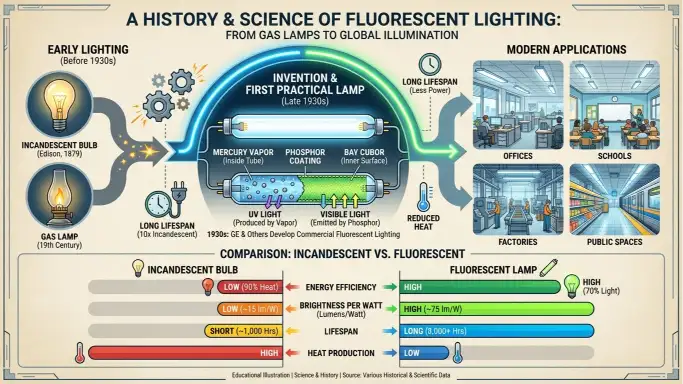
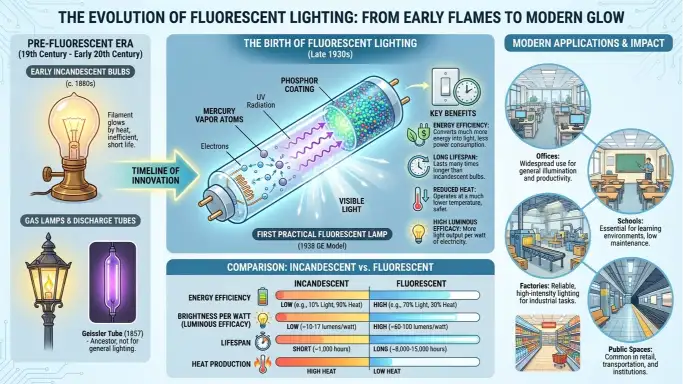
Fluorescent lights operate by passing an electric current through mercury vapor, which produces ultraviolet light. This ultraviolet light then excites a phosphor coating inside the tube, producing visible light.
This process explains why fluorescent lamps are much more efficient than incandescent bulbs and helps clarify when were fluorescent lights invented as a response to energy waste.
Why Fluorescent Lights Were Revolutionary
Fluorescent lights used far less electricity while producing more light. They also lasted significantly longer than traditional bulbs.
These advantages made the invention timeline behind when fluorescent lights invented a turning point in lighting history.
Table: Incandescent vs. Fluorescent Lights
| Feature | Incandescent Lights | Fluorescent Lights |
| Energy efficiency | Low | High |
| Heat production | Very high | Low |
| Lifespan | Short | Long |
| Brightness per watt | Low | High |
| Commercial adoption | Early 1900s | Late 1930s |
This comparison clearly shows why understanding when fluorescent lights were invented matters in the evolution of lighting technology.
Adoption During World War II
Fluorescent lights gained popularity during World War II, when energy efficiency became critical. Factories, military bases, and offices adopted them rapidly.
This period played a major role in spreading awareness of when fluorescent lights were invented and why they were essential.
Expansion into Homes and Offices
By the 1950s and 1960s, fluorescent lights became common in offices, schools, hospitals, and later in homes.
As their use expanded, more people became curious about when fluorescent lights were invented and how quickly they replaced older systems.
Economic Impact of Fluorescent Lighting
Fluorescent lights reduced electricity costs for businesses and governments. Large buildings could operate longer hours with lower energy bills.
This economic benefit added another reason why fluorescent lights were invented, marking an important milestone.
Environmental Benefits
Compared to incandescent bulbs, fluorescent lamps significantly reduced energy consumption. This helped lower carbon emissions from power plants.
Environmental discussions often reference when fluorescent lights were invented as an early step toward sustainable lighting.
Health and Workplace Productivity
Brighter, more uniform lighting improved visibility and reduced eye strain in workplaces and schools.
These improvements strengthened the importance of when fluorescent lights were invented in shaping modern work environments.
Challenges and Criticism
Despite their benefits, fluorescent lights contain small amounts of mercury, raising disposal and environmental concerns.
Even so, these challenges do not change when fluorescent lights were invented, only how they are managed today.
Transition to Compact Fluorescent Lamps (CFLs)
In the late 20th century, compact fluorescent lamps were introduced to replace incandescent bulbs in homes.
CFLs renewed public interest in when fluorescent lights were invented and how the technology continued to evolve.
Fluorescent Lights vs. LED Technology
Today, LEDs are replacing fluorescent lights in many applications. However, LED development would not have progressed as quickly without fluorescent lighting.
This connection reinforces the long-term importance of when fluorescent lights were invented.
Use in Public Infrastructure
Fluorescent lights became standard in airports, subways, shopping centers, and parking garages.
Public infrastructure improvements further highlight when fluorescent lights were invented as a key moment in urban development.
Educational Importance
Students studying physics and engineering often learn about fluorescent lighting to understand electricity, gases, and light emission.
This educational role keeps the question of when fluorescent lights were invented relevant for future generations.
Common Myths About Fluorescent Lights
Some believe fluorescent lights were invented after LEDs. In reality, they existed decades earlier.
Clearing such misconceptions helps accurately explain when fluorescent lights were invented.
Why Fluorescent Lights Still Matter
Even as newer technologies emerge, millions of fluorescent lights remain in use worldwide.
Their continued presence keeps when fluorescent lights invented an important historical question.
Cultural and Architectural Influence
Fluorescent lighting influenced modern architecture, enabling larger indoor spaces with consistent lighting.
This architectural impact further supports why fluorescent lights were invented, matters beyond science.
Lessons from the Invention
The story shows how scientific research, patience, and experimentation lead to lasting solutions.
This lesson is central to understanding when fluorescent lights were invented as part of human innovation.
Conclusion
So, when were fluorescent lights invented? The answer lies in the late 1930s, when scientists and engineers successfully transformed earlier experiments into practical lighting solutions. Their invention reshaped offices, factories, schools, and cities around the world.
From energy efficiency to environmental awareness, fluorescent lights changed how humanity thinks about illumination. Understanding when fluorescent lights were invented helps us appreciate the journey of technology that quietly lights our everyday lives.